
I’ve often wondered what The Glass Menagerie might have been like if playwright Tennessee Williams had the support he needed to make his 1944 autobiographically inspired play more true to his life as a gay man.
Uptown Players’ luminous regional premiere of Mother Play — A Play in Five Evictions by Paula Vogel, which originally opened on Broadway in 2024, 80 years after The Glass Menagerie debuted, plays through Sunday, August 30 in the Theatre Three space. Under the unerring direction of Cheryl Denson, with her finger on the pulse of the heart of this story, and three stirring performances, Mother Play offers a powerful look at what that might have been, how far we have come, with a nod to how far we still have to go.
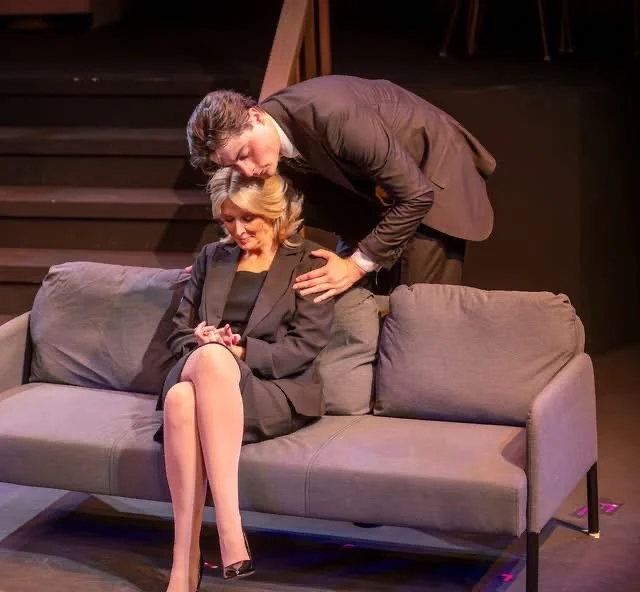
Cara Statham Serber as Phyllis (seated), Ryan Michael Friedman as Carl (standing). Photo by Mike Morgan.
Both The Glass Menagerie and Mother Play are autobiographically inspired “memory” plays for their authors. The style of writing is different — Williams dances poetically and waxes long while Vogel favors pungent prose in a 90-minute intermissionless format. But consider the family structure. Vogel gives us Phyllis, the mother of Mother Play, played with a dizzying mix of power and vulnerability by Cara Statham Serber, and her two children, the brilliant Carl (charismatically played by Ryan Michael Friedman) and the fragile — at least at first — daughter, Martha (compellingly portrayed by Leslie Marie Collins).
The dynamic is eerily similar to that of Amanda, the domineering mother in The Glass Menagerie, and her two children, Tom, the restless writer suffocated by small-town thinking and its restrictions, and Laura, who seems resigned to her fate.
Both plays hinge on a single mother who has been abandoned by her husband and any meaningful means of financial support. The mothers in both stories are controlling and judgmental in that brittle way that hides a terrified inner life. The mothers want something better for their children but they can’t stop telling them what to do long enough to listen to what they want and need to do. They listen to voices from the past (for Amanda these are her memories, for Phyllis, it is her racist, homophobic parents that we only imagine through one-sided phone conversations). Both mothers say and do things that are unforgivable.
And making each story wrenchingly personal, both playwrights have taken the name for the brother from life. Tennessee Williams’ given name was Tom (originally Thomas) — the name for the brother in The Glass Menagerie. And Vogel’s brother’s name was Carl — the name for the brother in Mother Play.
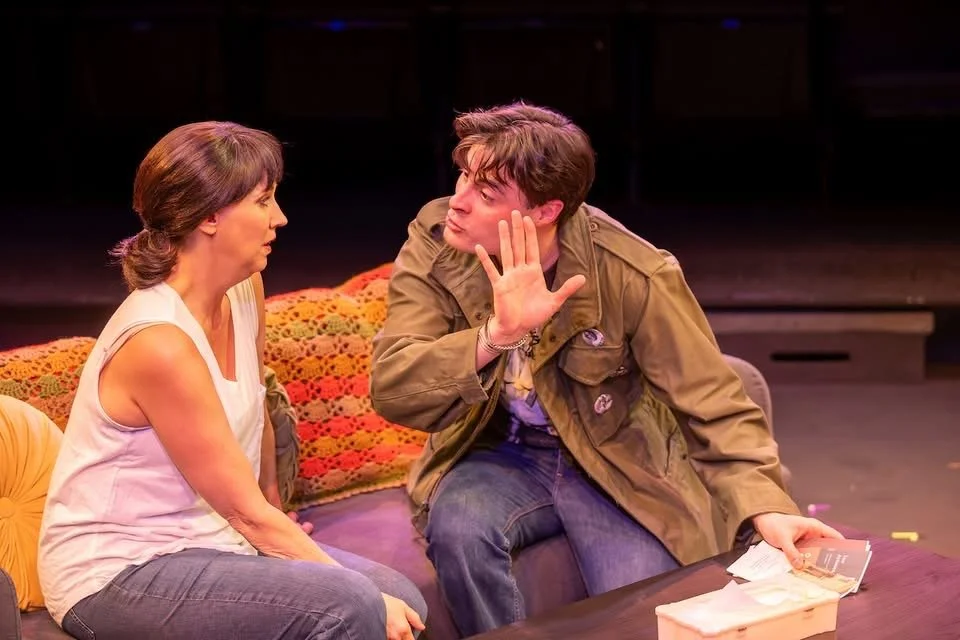
(l-r) Leslie Marie Collins as Martha and Ryan Michael Friedman as her brother Carl. Photo by Mike Morgan.
Mother Play opens in 1962, near Washington D.C. where the daughter, Martha, is examining a box of her brother’s belongings. She ruminates on what her brother meant to her and how frequently her family moved from one awful apartment to another. Then she moves back in time, remembering those moves that involved the packing and unpacking of boxes.
The play, structured by the evictions, take us to the changing dynamics among mother and children. They give us the gift of seeing these characters through the lens of decades (something we don’t get in The Glass Menagerie). Because Carl knows what his sister needs and pushes for her (in a way that Tom in The Glass Menagerie doesn’t), Martha will survive and thrive (in a way that Laura in The Glass Menagerie doesn’t).
Kevin Brown’s sets, tenderly lit by Kyle Harris, are evocatively simple and apt, with furniture quickly moved around the theater in the round with the suggestion of a kitchen at one end. Suzi Cranford’s costumes and Michael B. Moore’s hair, wig and make-up design usher us eloquently through the years.
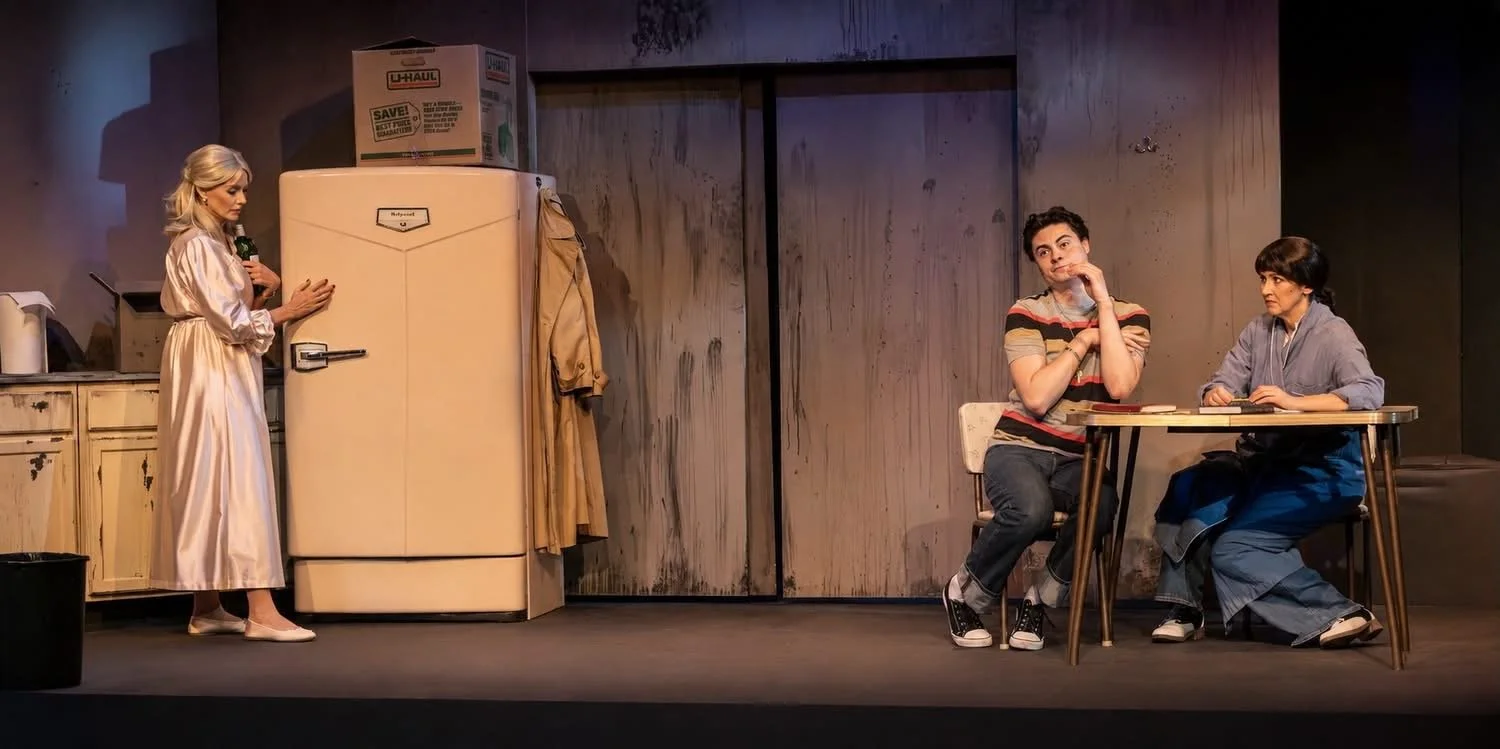
(l-r) Cara Statham Serber as Phyllis, Ryan Michael Friedman as Carol, Leslie Marie Collins as Martha Photo by Mike Morgan.
It is easy to get distracted by the armor of anger that Phyllis builds around herself, metallic scrap by scrap. But what Mother Play is more profoundly about is love and forgiveness.
Phyllis enrages and estranges both children, but is walking out — as each ultimately do — the end of the story? Vogel knows there is no true end without understanding and that there is no true understanding without love. Her characters are on a journey to find themselves and to find forgiveness because without that, we are not stuck, mired in fear and confusion as Phyllis is.
Compassion is the secret pulse of this play, just as it is of the theater itself. This story gains force by being experienced in a place where you sit next to strangers seeing an actor play someone on a stage that you might judge or condemn in real life. This story hits the heart when you realize that this person that you may not think you are capable of understanding is just another human who is struggling, who may have not gotten to where they need to go yet. This story builds urgency when you realize that this is about someone who might be guided in a better direction — or at least whose insults and actions hurt less when you understand that their anger is a reflection of them and not of you.
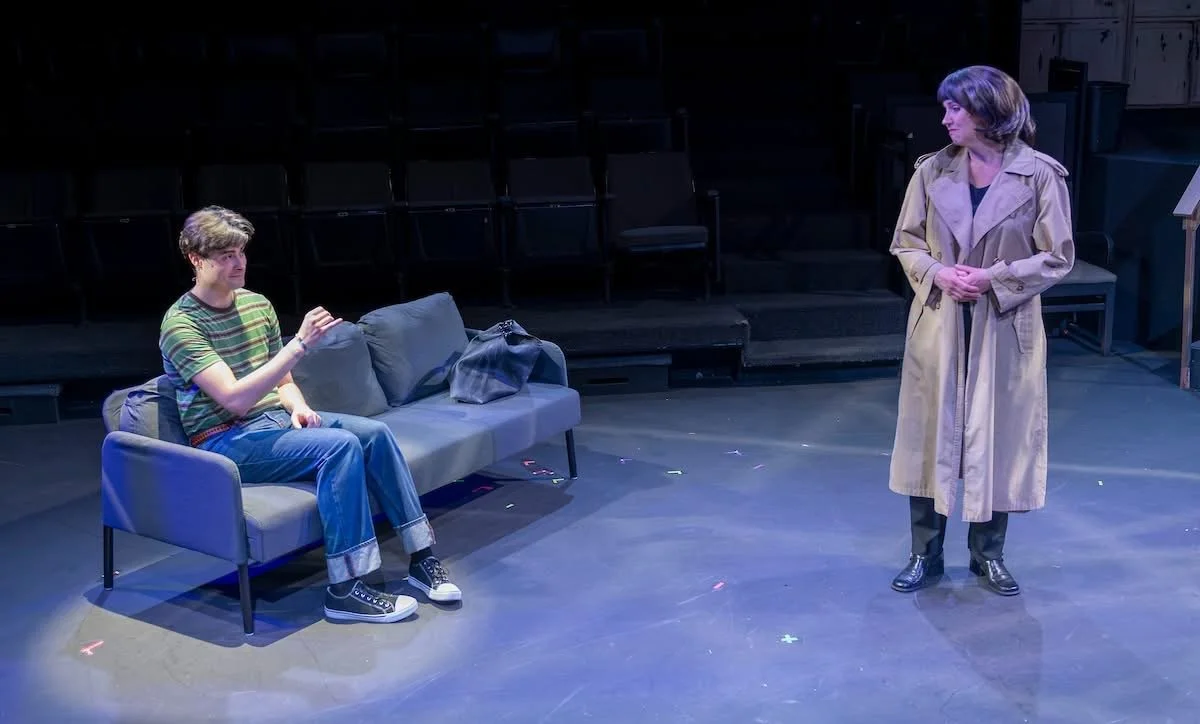
(from l-r) Ryan MIchael Friedman as Carl and Leslie Marie Collins as Martha. Photo by Mike Morgan.
Williams wrote: “…for nowadays the world is lit by lightning!” In Vogel’s hands, the lightning comes from these siblings who dare to be themselves seems brighter and more hopeful than the possibilities Williams might have dared to imagine in his time. I picture him, sitting by Carl Vogel, watching Mother Play from that big theater in the sky and smiling.
Don’t miss your final chances to take this journey with Uptown Players and this dazzling, transformative production.
Mother Play — A Play in Five Evictions by Paula Vogel, presented by Uptown Players at Theatre Three, continues through Sunday, August 30. 2688 Laclede St., Suite 120, Dallas. 214-219-2718 https://uptownplayers.org/show-details/mother-play